
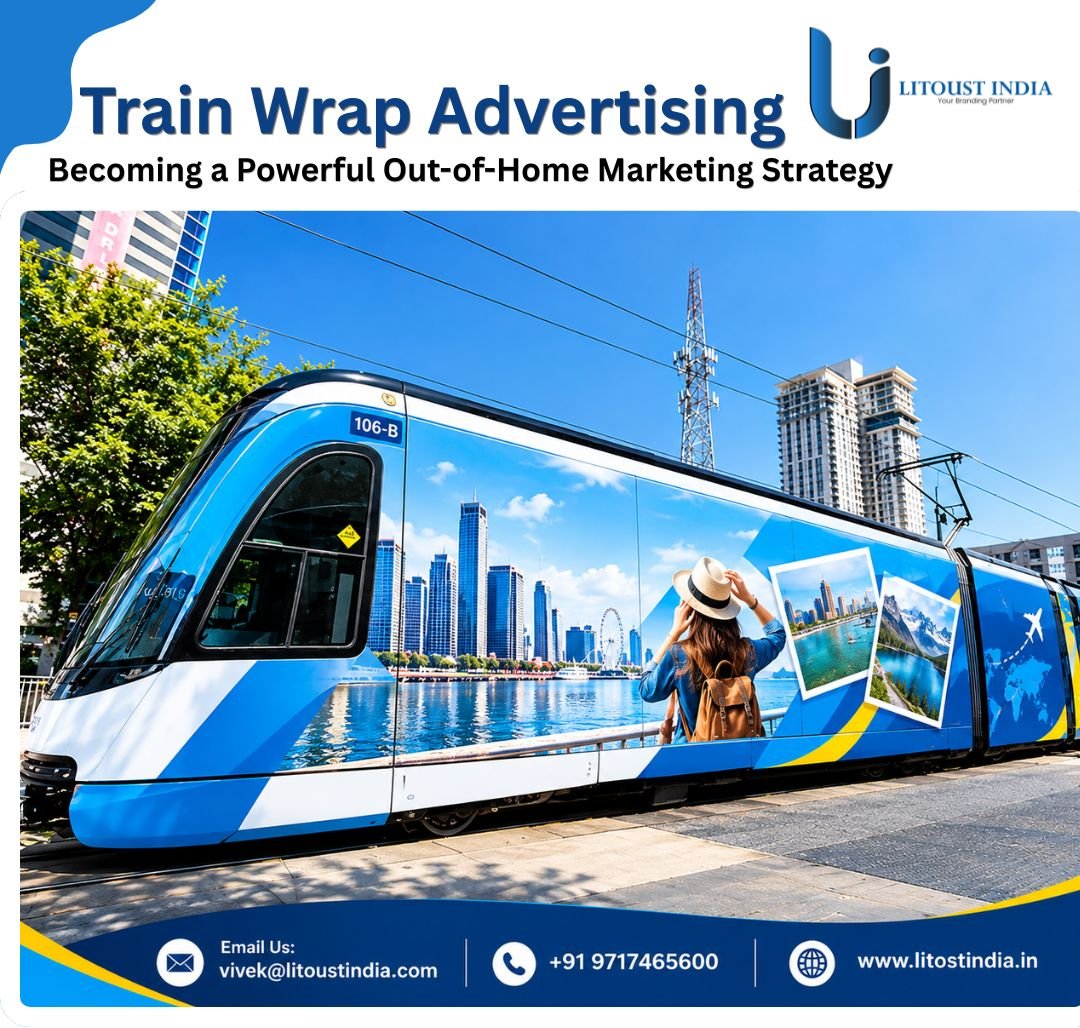
In a crowded advertising landscape, brands are constantly looking for ways to capture attention beyond digital screens and traditional billboards. Train wrap advertising has emerged as a high-visibility form of out-of-home (OOH) advertising that transforms trains into large-scale moving brand displays.
Instead of reaching audiences from a single fixed location, a branded train can travel across multiple routes, stations, neighbourhoods, and commuter touchpoints. This combination of mobility, scale, repetition, and visual impact makes train advertising an attractive option for brands looking to strengthen awareness and create memorable campaigns.
What Is Train Wrap Advertising?
Train wrap advertising involves applying branded graphics, campaign messaging, promotional artwork, or visual identity to the exterior or selected sections of a train.
Depending on the available advertising inventory, campaigns can include:
-
Full train wraps
-
Partial exterior wraps
-
Door and coach branding
-
Interior advertising
-
Station and platform branding
-
Special promotional campaigns
A professionally designed train wrap essentially turns an everyday transportation asset into a moving billboard, allowing brands to communicate with audiences throughout a train's journey.
Why Are Brands Investing in Train Wrap Advertising?
The growing interest in transit media comes down to one major advantage: high-visibility brand exposure in everyday environments.
Unlike online advertisements that compete with social posts, videos, notifications, and other digital content, OOH advertising exists within the physical environment. A creatively branded train can become part of a commuter's daily journey and generate repeated exposure over time.
1. High Visibility in Busy Urban Areas
Trains operate through areas where large numbers of people live, work, shop, and travel.
A branded train can potentially reach:
-
Daily commuters
-
Pedestrians
-
Road users
-
Passengers
-
Students
-
Tourists
-
Local residents
-
Business audiences
The large surface area also gives advertisers substantial creative space to communicate their brand.
2. Moving Brand Exposure
One of the biggest advantages of train wrap advertising is mobility.
A conventional billboard communicates with audiences from one fixed location. A wrapped train can travel through different parts of a city or region, creating multiple opportunities for people to encounter the same campaign.
For brands focused on awareness, recognition, and recall, repeated physical exposure can help reinforce the campaign message.
3. Strong Visual Impact
Train wraps provide a large canvas for creative storytelling.
Brands can use bold graphics, product imagery, campaign characters, taglines, and distinctive visual elements to create an advertising experience that stands out.
A successful train wrap should do more than display a logo. It should use the available space to create a visual identity that people can understand quickly.
Choosing the Right Train Advertising Partner
The success of a train wrap campaign depends not only on the creative concept but also on planning, production, media coordination, and execution.
Companies such as Litoust India can be considered when brands are looking for professional support for transit and outdoor advertising campaigns. Working with an experienced advertising partner can help businesses evaluate available media options, develop campaign creatives, coordinate production, and plan the execution according to the requirements of the selected advertising network.
For brands planning a train branding campaign, it is important to discuss the target audience, routes, campaign duration, available inventory, creative specifications, production requirements, and expected campaign objectives before finalizing the media plan.
Train Wrap Advertising vs Traditional Outdoor Advertising
Train wrap Branding is part of the broader OOH advertising ecosystem, but its mobile nature creates a different advertising experience.
|
Advertising Format |
Main Advantage |
|
Billboards |
Strong visibility at fixed locations |
|
Bus Advertising |
Mobile exposure across road networks |
|
Metro Advertising |
Access to urban commuters |
|
Airport Advertising |
Premium audience and high dwell time |
|
Train Wrap Advertising |
Large-scale mobile brand visibility |
|
Digital OOH |
Dynamic and frequently changing content |
The right format depends on the campaign objective, target audience, location, budget, and desired frequency of exposure.
What Makes a Successful Train Wrap Campaign?
A successful campaign starts with a strong creative idea, but execution is equally important.
Keep the Message Simple
People may see a moving train for only a short period. The primary message therefore needs to be understood quickly.
A strong design generally prioritizes:
Brand → Message → Visual → Call to Action
Trying to communicate too much information can reduce the impact of the campaign.
Make the Brand Recognizable
The logo, brand colours, typography, product imagery, and other distinctive elements should be easy to identify without making the design feel overcrowded.
Design Around the Train's Structure
Train advertising is different from designing a conventional billboard. The creative needs to account for:
-
Doors
-
Windows
-
Curved surfaces
-
Coach divisions
-
Handles and fixtures
-
Safety markings
-
Technical restrictions
A design that looks impressive on a computer screen may not work equally well when applied to the actual train.
How Train Wrap Advertising Supports Brand Awareness
The primary role of many OOH campaigns is not necessarily an immediate transaction. Instead, they help build brand familiarity and recognition.
When commuters repeatedly see the same branded train, the campaign can become more familiar over time. This can be particularly useful for:
-
Consumer brands
-
Automotive companies
-
Real estate developers
-
Educational institutions
-
Technology companies
-
Retail brands
-
Entertainment campaigns
-
Financial services
-
Tourism brands
For product launches and large awareness campaigns, train advertising can also complement digital, social media, search, television, and other marketing channels.
Integrating Train Advertising With Digital Marketing
One of the most effective modern approaches is to connect offline advertising with online engagement.
A train campaign can include:
-
QR codes
-
Campaign hashtags
-
Short URLs
-
Promotional offers
-
Social media activations
-
Dedicated landing pages
A commuter may first discover the campaign on a train and then interact with the brand online.
This creates a bridge between physical OOH advertising and digital marketing, allowing brands to build a more connected customer journey.
Is Train Wrap Advertising Suitable for Every Brand?
Not necessarily.
Train advertising works particularly well when a campaign requires high visibility, strong visual branding, and broad audience exposure.
Before choosing this format, advertisers should consider:
-
Target audience
-
Train routes and locations
-
Campaign duration
-
Advertising inventory
-
Creative requirements
-
Production and installation costs
-
Expected audience exposure
-
Campaign objectives
-
Measurement approach
The advertising format should ultimately support the campaign objective rather than being selected simply because the advertising space is available.
How Much Does Train Wrap Advertising Cost?
There is no single fixed price for train wrap advertising.
Campaign costs can vary depending on:
-
Train network and city
-
Number of trains or coaches
-
Type of wrap
-
Advertising duration
-
Surface area
-
Printing and production
-
Installation and removal
-
Route and audience profile
-
Media-owner charges
-
Campaign customization
Brands should therefore request a campaign-specific quotation based on their requirements instead of relying on a generic price.
How to Plan a Train Wrap Advertising Campaign
Step 1: Define the Campaign Objective
Determine whether the goal is:
-
Brand awareness
-
Product launch
-
Event promotion
-
Market expansion
-
Lead generation
-
Seasonal promotion
-
Brand repositioning
Step 2: Identify the Target Audience
Understand who the campaign needs to reach and where those audiences travel.
Step 3: Select the Right Train Inventory
The route, network, coach type, campaign duration, and available advertising inventory can significantly influence campaign performance.
Step 4: Develop the Creative
Create artwork specifically for the train rather than simply adapting a standard billboard design.
Step 5: Manage Production and Installation
Artwork needs to be produced using suitable materials and installed according to the advertising and transportation requirements.
Step 6: Measure Campaign Performance
Depending on the campaign, measurement can include:
-
Estimated impressions
-
Reach and frequency
-
QR-code scans
-
Website traffic
-
Search interest
-
Social media engagement
-
Brand-lift studies
-
Campaign-specific enquiries
The Future of Train Wrap Advertising
OOH advertising is evolving as brands look for ways to combine physical visibility with digital engagement.
Train advertising is well positioned within this shift because it offers something digital advertising cannot fully replicate: a large physical brand presence in the real world.
Future campaigns are likely to focus more on creative experiences, data-informed media planning, integrated digital activations, and measurable outcomes.
Rather than treating train advertising as an isolated offline channel, brands can use it as part of a broader omnichannel marketing strategy.
Final Thoughts
Train wrap advertising is becoming a powerful OOH marketing strategy because it combines scale, mobility, visibility, and creative freedom. Instead of communicating with audiences from one fixed location, a branded train can take a campaign through multiple commuter touchpoints.
For brands looking to create memorable physical visibility, train wraps can be particularly valuable when integrated with digital campaigns and supported by a clear media strategy.
If you are planning a transit branding campaign, working with an experienced outdoor advertising partner such as Litoust India can help bring together media planning, creative execution, production, and campaign requirements in one coordinated approach.
The goal is not simply to wrap a train—it is to create a campaign that people can recognize, remember, and connect with the brand.
Questions & Answers
Everything you need to know about this campaign strategy, media placement options, and execution timelines.